Platelet Count in Dengue: What You Need to Know
June 22, 2026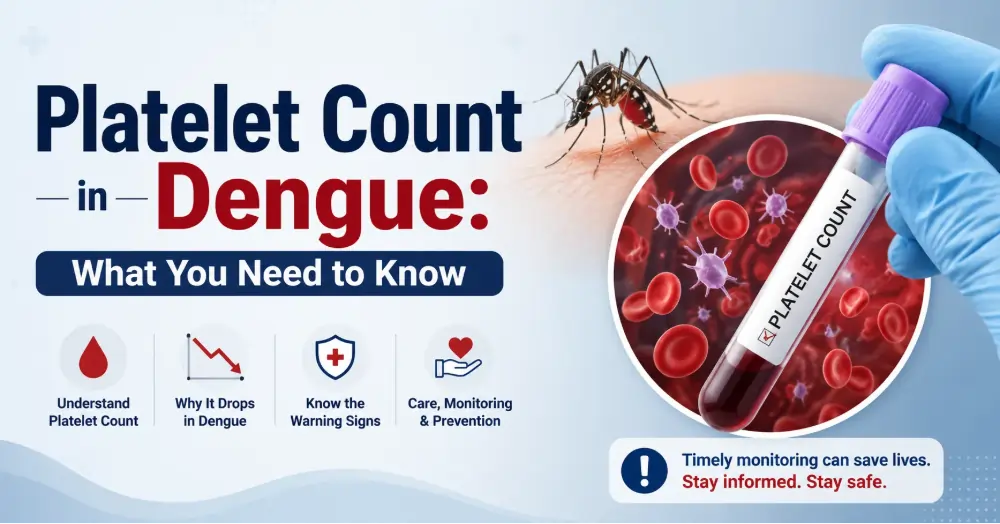
Platelet count is one of the first things doctors track when dengue is suspected. And for good reason. The dengue virus attacks the very cells your blood depends on for clotting, causing a rapid decline that can escalate from uncomfortable to dangerous within days.
Nearly half the world's population lives under the threat of dengue. Each year, an estimated 100 to 400 million infections occur globally. In India, the monsoon months bring a predictable surge, and with it, a wave of anxious CBC reports and falling platelet numbers.
This blog covers what platelet count means, why it falls during dengue, how it differs across age groups, and what you can actually do about it.
What is a Platelet Count?
Platelets, or thrombocytes, are tiny colourless cell fragments produced in the bone marrow. Their job is simple: when a blood vessel is damaged, they rush to the site, bind to a protein called fibrinogen, and form a clot. In simple terms, if you cut your finger, scrape your knee, or undergo surgery, platelets are what stop the bleeding.
A platelet count (PLT) measures how many platelets are present in a microlitre of blood. It is usually part of a Complete Blood Count (CBC) test, which also tracks white blood cells and red blood cells.
Normal platelet count in a healthy adult: 1,50,000 to 4,50,000 per microlitre of blood.
Why Does Dengue Cause Platelet Count to Drop?
Dengue spreads through the bite of Aedes mosquitoes, mainly Aedes aegypti and Aedes albopictus. Standing water, humidity, and poor sanitation all help these mosquitoes breed, which is why India sees a spike every monsoon season.
When the virus enters the bloodstream, it affects bone marrow, where platelets are made. Two processes occur at the same time:
- The virus slows down platelet production directly in the bone marrow.
- The immune system, in trying to fight the infection, starts attacking healthy platelets by mistake.
With production slowing and destruction accelerating, platelet counts can fall considerably within just a few days.
How Platelet Count Changes Day by Day in Dengue
A drop in the platelet count during dengue infection can cause panic in patients. However, knowing what to expect can make the process less alarming and help you act at the right time.
Day-wise platelet count change in dengue:
- Days 1-4, febrile phase - accompanied by high fever, severe body aches and platelet count begins to drop gradually.
- Days 4-7, critical phase - you may experience a break in fever, but this is where platelets drop to their lowest point (called the nadir) and the risk of plasma leakage increases.
- Days 7-10+, recovery phase - in this phase, bone marrow recovers, and the platelet count starts to increase significantly, coming down to the normal levels within a week.
Platelet Count by Age Group: Normal Range vs. During Dengue
Dengue doesn't hit every age group the same way. Baseline platelet levels vary across life stages, and the absolute number that signals danger shifts depending on who is holding that CBC report.
|
Age Group |
Normal Platelet Count (per µL) |
Typical Range During Dengue |
When to Seek Help |
Key Note |
|
Newborns (0-28 days) |
1,35,000-4,30,000 |
Can drop below 1,00,000 |
Below 1,00,000 - any bleeding sign |
Dengue in newborns is rare but serious |
|
Infants (1-12 months) |
2,00,000-5,00,000 |
50,000-1,00,000 in moderate cases |
Below 1,00,000 - immediate paediatric review |
Higher baseline than adults |
|
Children (1-14 years) |
1,65,000-4,73,000 |
Often 50,000-1,00,000 |
Below 50,000 - hospitalisation typically advised |
In dengue in children, the drop looks steeper due to the high baseline |
|
Teenagers (15-17 years) |
1,50,000-4,50,000 |
Can fall to 20,000-80,000 in severe cases |
Below 50,000 - watch for bleeding |
Adults experience more severe thrombocytopenia than children |
|
Adults (18-59 years) |
1,50,000-4,50,000 |
20,000-1,00,000 at nadir |
Below 50,000 - transfusion considered |
Intrinsically lower counts and greater bleeding risk vs children |
|
Pregnant Women |
1,00,000-3,50,000 (lower baseline during pregnancy) |
Can drop sharply, worsened by gestational changes |
Below 50,000 or any bleeding - emergency care |
Dengue in pregnancy adds a second layer of pressure on an already shifted baseline |
|
Elderly (60+ years) |
1,50,000-4,00,000 (slight decline with age) |
Similar drop to adults. Slower recovery |
Below 50,000 - underlying conditions add risk |
Bone marrow response slows with age |
When it comes to young people, being treated at the right time by a reputed paediatric hospital in Hyderabad is what counts the most. Apollo Cradle & Children's Hospital has specialist teams equipped to manage dengue in infants and children through every stage of the illness. Pregnant women with falling platelet levels should not wait either. The hospital is known as one of the best maternity hospitals in Hyderabad for providing obstetrics services.
Normal and Critical Platelet Levels in Dengue
A healthy adult has between 1,50,000 and 4,50,000 platelets per microlitre of blood. When dengue enters the picture, that number can fall into three broad zones:
- Mild thrombocytopenia: 1,00,000 to 1,50,000 - below normal but typically manageable with close monitoring at home.
- Moderate thrombocytopenia: 50,000 to 1,00,000 - this is where most dengue patients land during the critical phase. Hospitalisation is often advised.
- Severe thrombocytopenia: Below 50,000 - requires very close medical supervision and possible platelet transfusion.
Signs of Low Platelet Count During Dengue
Low platelet count does not always show, and some of its signs are easy to miss.
- Easy bruising or skin changes
- Bleeding from the nose or gums
- Abdominal pain
- Blood in vomit
- Black or tarry stool, or visible blood in stool
- Heavy menstrual bleeding in women during active dengue (one many overlook) - this can indicate platelet counts are critically low.
How to Increase Platelet Count in Dengue?
- Consume a diet rich in vitamin C, B12, folate, and iron.
- Drink water, coconut water, or clear broths. Skip caffeine and sugar.
- Sleep 7 to 9 hours, as platelets are produced while your body rests.
- Walking and stretching aid circulation. Avoid anything strenuous.
- Skip aspirin and ibuprofen. They raise the bleeding risk significantly.
- Only take prescribed bone marrow stimulants. Paracetamol is safe for fever.
- Critically low counts may need a transfusion. Always done under medical supervision.
When to Go to the Hospital Immediately
Do not wait to see if things improve on their own in these situations:
- Platelet count drops below 50,000 per microlitre
- Severe or unexplained bleeding from the nose or gums
- Blood in vomit, urine, or stool
- Unusual bruising with no apparent cause
- Persistent exhaustion that is not improving after the fever breaks
- Heavy menstrual bleeding in women during active infection
A falling platelet count is not always a crisis on its own. But combined with any of the above symptoms, it demands prompt evaluation.
Yes, in milder cases. Once the virus starts to clear, bone marrow usually begins producing platelets again fairly quickly.
Most hospitals consider counts below 50,000 to be a trigger for close inpatient monitoring. Below 20,000, the risk of spontaneous bleeding rises sharply. These are not absolute cut-offs but are general clinical thresholds used to guide treatment decisions.
Foods, like raw garlic, onion, and ginger in large quantities, can mildly inhibit clotting. Processed and packaged foods and caffeinated beverages are worth avoiding. Papaya leaves, despite circulating claims about their benefits, contain compounds that can cause gastrointestinal irritation. Stick with papaya fruit instead.
A few things that consistently help: ● Mosquito repellents containing DEET, picaridin, or oil of lemon eucalyptus on exposed skin ● Sleeping under mosquito nets, especially during peak hours around dawn and dusk ● Wearing full-sleeve clothing during the July to November dengue season in India ● Eliminating stagnant water around the home. Tyres, containers, coolers, and flower pots are all common breeding grounds.

Copyright @ 2026,Apollo Cradle. All Rights Reserved